Breaking the Stalemate and Stabilization Strategies for Midlife Marital Apathy
先看完案例关键信息,再进入分析页验证自己的结构与阶段。
Client Background
The client is a man in his fifties with a stable career and ordinary family life. However, in recent years, he has felt his marriage gradually entering a phase of apathy, with reduced communication between spouses and growing emotional distance, causing him significant confusion and anxiety. He wishes to understand whether his current marital situation has the potential for long-term stability and how to effectively break the stalemate to rebuild intimacy.
His lifestyle is relatively regular, with moderate work pressure. His personality tends to be introverted but with definite opinions. The marital issues did not arise suddenly but accumulated over time, manifesting as reduced emotional expression and lack of mutual understanding. The client is eager to find the deeper causes of his marital status from a BaZi perspective and seek practical improvement advice.
BaZi Chart Structure Interpretation
From a BaZi perspective, the client’s Day Master is 戊土 (Wu Tu, Yang Earth), which is slightly over-strong. This indicates traits of resilience and responsibility, but an over-strong Earth element can also bring stubbornness and emotional buildup. The Yang Ren (羊刃) pattern intensifies his personal willpower and drive. While beneficial for career advancement, it may cause dominance and conflict in emotional relationships.
His current Da Yun (大运, decade luck cycle) is 乙卯 (Yi Mao), representing a stable phase that encourages preservation and steadiness. However, the Liu Nian (流年, annual fortune) of 丙午 (Bing Wu) introduces Fire energy, symbolizing vitality and change but also potentially aggravating the Ji Shen (忌神, unfavorable element) Fire, increasing emotional volatility. The Yong Shen (用神, favorable element) is Metal, symbolizing rationality, communication, and harmony, suggesting he needs to leverage rational communication and external resources to ease internal pressure and marital tension.
The appearance of Ji Shen Fire in the Liu Nian indicates possible emotional 'burning' or conflict in the current relationship, with emotions prone to intense fluctuations. Without effective release, misunderstandings and estrangement may arise. Overall, the chart shows the client must learn to use the harmonizing effect of Yong Shen Metal to balance his strong inner tendencies and external environmental changes to stabilize the marriage.
Focused Issue Assessment
Regarding the question of whether this relationship can maintain long-term stability, BaZi indicates stability is possible but requires proactive adjustment. The strong Earth and Yang Ren pattern bring intense personality and dominance desires; without harmonization, the marriage risks falling into a tense and apathetic vicious cycle. Although the current Da Yun Yi Mao is stable, the impact of Liu Nian Bing Wu Fire reminds the client that emotional management and communication are key.
The presence of Yong Shen Metal suggests that through rational communication and wise adjustments, the marital relationship can be repaired. The client should focus on listening to his spouse’s needs, reduce his own dominant expressions, and avoid impulsive conflicts triggered by the Ji Shen Fire. Emotional repair requires time and patience, as well as external positive support, such as family counseling or joint activities.
In the long term, the relationship has a stable foundation, but stability is not automatic and requires mutual effort. If the client ignores the guidance of Yong Shen Metal and continues acting stubbornly with his over-strong Earth, the marriage will be difficult to sustain. Both parties’ attitudes and behaviors in facing changes will directly influence the relationship’s trajectory.
Recommended Actions and Timing
First, the client should start with emotional expression, actively reducing the stubbornness caused by the over-strong Earth and cultivating patience and tolerance. Specific actions include scheduling fixed daily times to communicate feelings with his spouse to avoid emotional buildup. Utilizing the rational strength of Yong Shen Metal, he should learn effective communication skills and try to understand and respond to his spouse’s needs.
Second, the current late stage of Da Yun Yi Mao combined with the influence of Liu Nian Bing Wu indicates this year is a period for adjustment, suitable for attempts at emotional management and relationship repair. The client may consider appropriate family or marriage counseling or participate in shared interest activities to enhance intimacy and interaction frequency. Avoiding intense quarrels and emotional outbursts is important to create a harmonious environment.
The next one to two years represent a critical window, especially regarding the emotional impact of annual fortune changes. It is recommended that after entering a new Da Yun next year, the client continues consolidating communication achievements and adjusts strategies as needed, relying on the wisdom of Yong Shen Metal to gradually resolve risks brought by Ji Shen Fire and achieve stable marital improvement.
Review and Reminders
Marital stability is influenced not only by BaZi but more importantly by the actual actions and attitudes of both parties. The client must be wary of impulsiveness and stubbornness caused by the over-strong Yang Ren pattern, avoiding imposing personal emotions on his spouse. Long-term neglect of communication and emotional management easily leads to deterioration and irreparable rifts.
Furthermore, although destiny provides general direction and trends, life contains many variables. The client is advised to combine BaZi insights with active emotional management, maintaining patience and flexibility, and avoiding a passive mindset of 'fate determines all.' Only through proactive adjustment and sincere effort can long-term marital stability be realized.
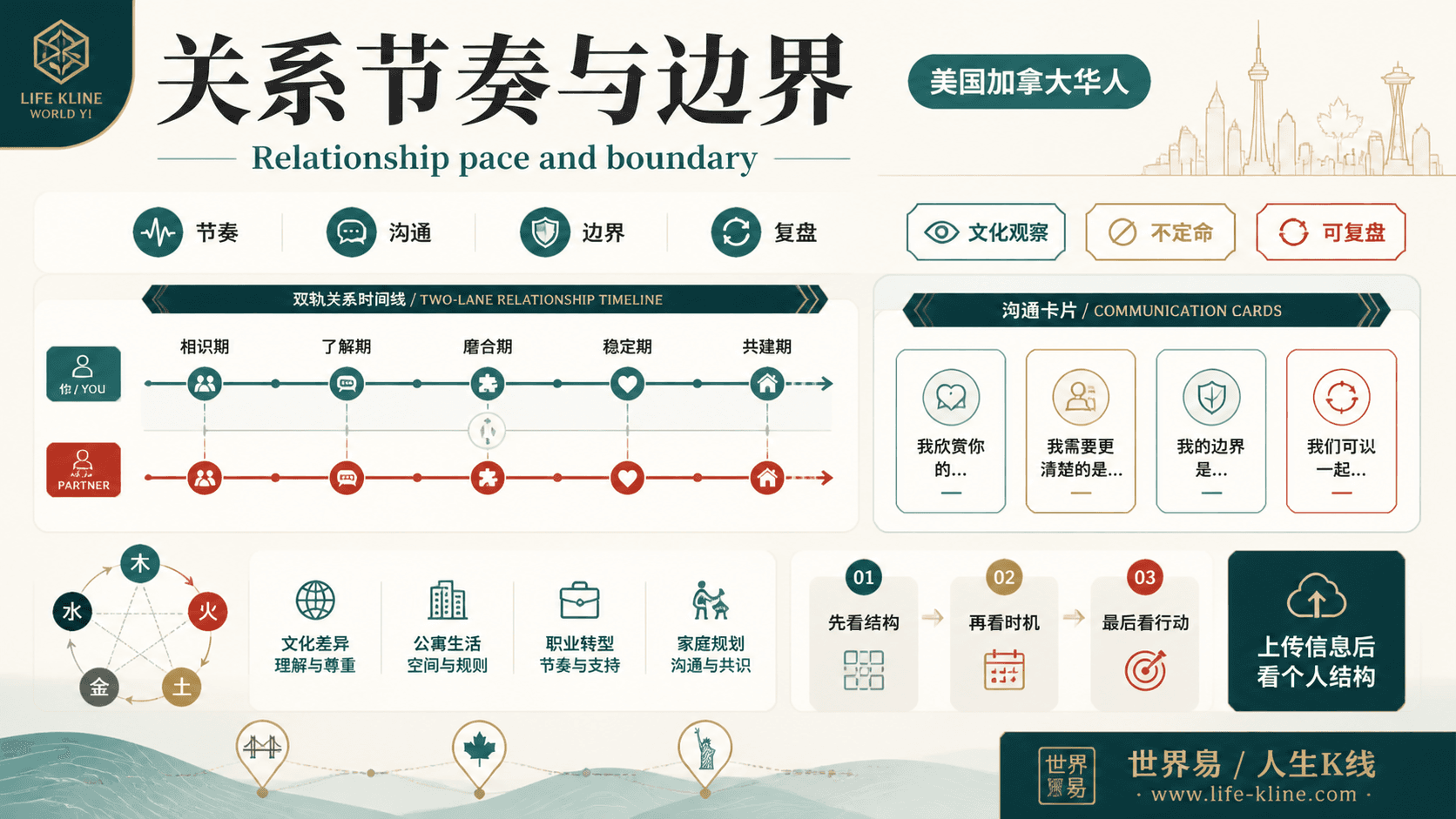
关系节奏与边界|美国加拿大华人
这张图把《Breaking the Stalemate and Stabilization Strategies for Midlife Marital Apathy》里的命理概念转成关系、边界和应用场景,适合先看图建立结构,再回到案例正文理解细节。
关系节奏与边界不应被写成固定结论。更适合美国加拿大华人的读法,是把传统术语翻译成结构、时机、环境、行动和复盘。
查看图片解读