Lifestyle Adjustments and Metaphysical Guidance in Chronic Disease Care
先看完案例关键信息,再进入分析页验证自己的结构与阶段。
Client Background
The client is a woman between 35 and 40 years old, currently at a pivotal stage in her career while also bearing the responsibility of caring for her parents with chronic illnesses. Her family life is quite busy, and her parents' health significantly impacts her psychological state and time management. She hopes to adopt a scientific lifestyle that aligns with her own BaZi characteristics to help her parents receive better daily care and to prevent health issues caused by caregiving stress.
Because the client's Day Master (Ri Zhu) is relatively weak and she is currently in the Ding You (丁酉) Da Yun, a phase of maintaining achievements, she feels confused about her current lifestyle pace and health regimen. She especially seeks a lifestyle adjustment plan that is both consistent with her BaZi and practically feasible to promote her parents' health.
BaZi Chart Structure Interpretation
The client's BaZi chart belongs to the Bi Jian (Peer) pattern, with a weak Gui Water (癸) Day Master, indicating insufficient personal energy that requires external support to enhance vitality. Wood is the Yong Shen (favorable element), meaning growth and nourishment are the key directions for the chart. It is suitable to enhance overall energy and health by fostering a vibrant environment and lifestyle habits.
Fire is the Ji Shen (unfavorable element), which consumes Water energy in the chart, causing excessive depletion and internal strain. This manifests as emotional fluctuations or physical exhaustion. Therefore, lifestyle settings should avoid overwork and emotionally intense environments. Although the current Ding You Da Yun and Bing Wu Liu Nian are relatively stable phases, the presence of Fire in the Liu Nian calls for flexibility to prevent health impacts from environmental or emotional Fire energy.
Overall, the chart suggests the client should focus on nourishment, relaxation, and vitality, emphasizing the adjustment of Wood elements in daily life, such as increasing green plants, balanced diet, and gentle exercise, while minimizing Fire stimulation to maintain physical and psychological balance.
Focus Issue Assessment
Regarding chronic disease care for the parents, lifestyle alignment should first consider how to help both the parents and the client strengthen the Yong Shen Wood in their BaZi charts. Wood symbolizes growth and renewal, making it appropriate to introduce habits that promote blood circulation and enhance immunity, such as moderate morning sun exposure, light outdoor exercise in green environments, and a diet rich in vegetables containing vitamins and minerals.
The Ji Shen Fire warning suggests that the client and family members should avoid excessive consumption of fried, spicy, and warming foods to prevent Fire energy from rising and aggravating chronic disease symptoms. This also helps stabilize the client's emotions, reducing irritability and fatigue caused by caregiving stress.
Considering that the Ding You Da Yun is a phase of maintaining achievements, it is not advisable to make drastic lifestyle changes at this stage. Instead, adjustments and optimizations should be gradual. The Bing Wu Liu Nian has relatively strong Fire energy; while flexible adaptation is necessary, more emphasis should be placed on balancing Fire and Water to ensure a steady lifestyle rhythm and avoid excessive emotional or environmental stimulation.
Recommended Actions and Timing
First, it is recommended to start with dietary adjustments by immediately reducing the intake of spicy and fried foods, and increasing green leafy vegetables and foods rich in Wood energy, such as celery, spinach, and legumes. This step is suitable for gradual implementation during the current Bing Wu Liu Nian, leveraging the strong Fire energy of the year to transform it into vibrant Wood energy and mitigate Fire's negative effects.
Second, arrange at least three outdoor activities per week in environments rich with vegetation, such as walking or light exercise like Tai Chi or yoga. This helps the body absorb the growth power of Wood and regulate the nervous system. Given the maintaining nature of the Ding You Da Yun, the exercise intensity should not be too intense, adhering to the principle of moderation for sustainable long-term practice.
Finally, it is advised to establish a fixed daily routine, avoiding staying up late and emotional fluctuations, especially in the mid to late period of the Liu Nian. Gradually strengthening the regularity of the schedule helps reduce the interference of Fire energy on the body and stabilizes the Water foundation. These adjustments can continue over the next one to two years, with further refinements as health improves.
Review and Reminders
During the implementation of lifestyle adjustments, common pitfalls include impatience for quick results or neglecting the individual constitutional differences between the client and her parents, resulting in health regimens that are hard to sustain or poorly adapted. Balancing the Yong Shen and Ji Shen in BaZi is especially important; one should avoid emotional Fire caused by caregiving stress, which can worsen health burdens.
Furthermore, although destiny offers guidance, lifestyle details still require flexible adjustments based on actual circumstances. It is recommended that the client regularly reviews the effectiveness of the adjustments, monitors the physical responses of both her parents and herself, and continuously optimizes the plan to ensure that the lifestyle truly complements the Yong Shen in BaZi, achieving the best state of health maintenance.
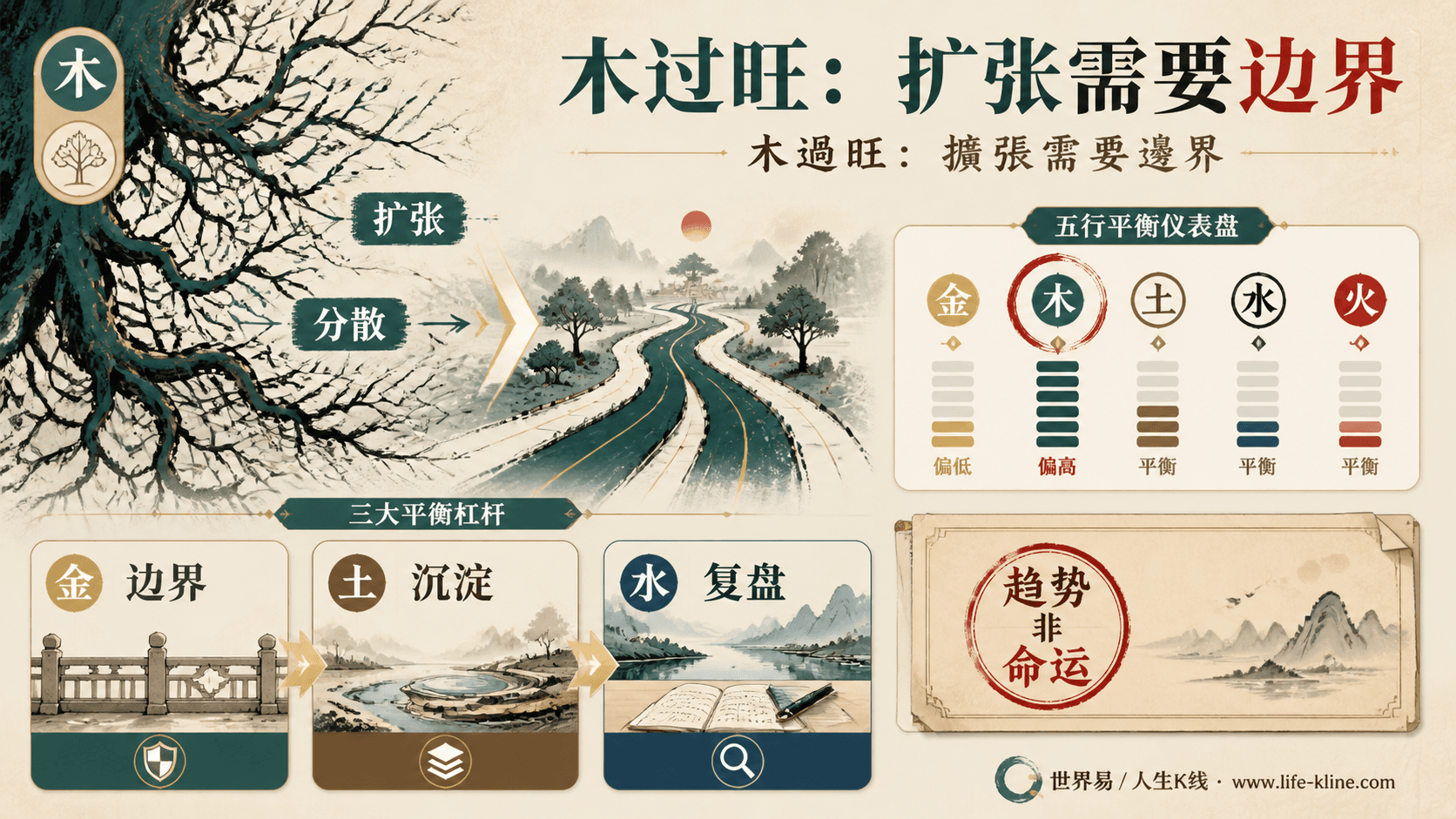
木过旺与再平衡
这张图把《Lifestyle Adjustments and Metaphysical Guidance in Chronic Disease Care》里的命理概念转成关系、边界和应用场景,适合先看图建立结构,再回到案例正文理解细节。
木过旺常表现为扩张过快、计划繁多、方向分散。在人生K线系统中,这是一种时位特征,而非固定标签。通过引入边界、沉淀与复盘,可实现自然再平衡,导向更可持续的结构。
查看图片解读