Key Nourishing Stages During Postpartum Depression Recovery Period
先看完案例关键信息,再进入分析页验证自己的结构与阶段。
Client Background
The client is a 45-year-old woman who has undergone the physical and mental adjustment period following postpartum depression. She currently faces slow recovery with fluctuating physical and emotional states, particularly noticeable during seasonal changes and emotional upheavals. As an important family member, maintaining a healthy and stable condition is crucial to her quality of life and family atmosphere.
Her occupation is clerical work, which is relatively busy and mentally stressful. The burden of caring for her child and family postpartum has left her physically and mentally exhausted. Recently, she hopes to improve her postpartum depression recovery by adjusting her lifestyle and health practices, especially focusing on which stages require key nourishment to achieve better rehabilitation results.
BaZi Chart Structure Interpretation
The BaZi chart shows her Day Master as 甲 (Jia) Wood, which is relatively weak overall, indicating insufficient vitality and recovery ability. This requires special attention to supplementation and nurturing. She belongs to the Bi Jian (比肩) pattern, meaning her environment and peer support have significant influence, but her own energy is limited and easily depleted by external pressures.
The Yong Shen (用神) is Water, which nourishes Wood, helping to strengthen vitality and regulate emotions. Therefore, the nourishment should focus on supplementing Water elements, such as adjusting diet and daily routine to enhance internal Water Qi. The Ji Shen (忌神) are Fire and Earth, which exacerbate internal depletion and emotional fluctuations. Especially when Fire is strong, it tends to trigger anxiety and insomnia; excessive Earth causes heaviness and fatigue in the body. Hence, environments and habits that intensify Fire and Earth should be avoided.
She is currently in the mid-phase of the 己亥 (Ji Hai) Da Yun, with overall stable luck, favoring consolidation rather than aggressive advancement, which is conducive to steady recovery. The Liu Nian (annual fortune) is 丙午 (Bing Wu), with strong Fire energy that may cause fluctuations in emotions and physical energy. Special attention is needed to the nourishment rhythm during this Liu Nian to prevent exacerbation of emotional instability caused by excessive Fire.
Focused Problem Assessment
Regarding the question of ‘which stages require key nourishment,’ the BaZi chart indicates that the initial stage of recovery is particularly critical. At this time, the body is weak, with Wood weak and Water insufficient. If Water and Yin are not promptly supplemented, depressive symptoms may prolong and physical fatigue worsen. Therefore, the first year postpartum should focus on supplementing Water and nurturing Yin, regulating emotions, and avoiding excessive fatigue and emotional fluctuations.
Secondly, the Liu Nian of 丙午 (Bing Wu) with strong Fire is the second key period for nourishment. Strong Fire easily causes internal heat and restlessness. Especially during the 丙午 Liu Nian, the influence of Fire increases, potentially leading to emotional loss of control and poor sleep. During this period, psychological counseling and physical cooling supplementation should be strengthened, increasing Water intake appropriately to avoid repeated flare-ups caused by excessive Fire.
Additionally, the overall stable 己亥 (Ji Hai) Da Yun is suitable for consolidation and recuperation, avoiding intense exercise and excessive mental stress. Nourishment during this phase should emphasize peace and stability, focusing on regular lifestyle and balanced mindset, avoiding cumulative damage from the Ji Shen Fire and Earth, promoting dual recovery of physical Qi and blood as well as mental state.
Recommended Actions and Timing
During the first year postpartum recovery, emphasis should be placed on nourishing Water and nurturing Yin through health preservation measures. It is recommended to increase intake of foods with Yin-nourishing and moisturizing properties, such as Tremella (银耳), lily bulbs (百合), and lotus seeds (莲子), while avoiding spicy and drying foods. Ensure sufficient sleep and engage in gentle aerobic exercises like walking and yoga to help regulate emotions and strengthen physical constitution.
During the current Liu Nian of 丙午 (Bing Wu), special attention must be paid to emotional management and physical nourishment. Practices such as meditation and breathing exercises can reduce internal Fire, alleviating anxiety and restlessness. Avoid staying up late and overexertion. It is suitable to participate in psychological counseling or emotional guidance courses to stabilize the mind and prevent depressive relapses caused by excessive Fire.
In the next two years, it is advisable to maintain the consolidation strategy of the 己亥 (Ji Hai) Da Yun, continuing to sustain a stable lifestyle rhythm and emotional state. Regular physical examinations are recommended, with attention to liver and kidney function, as Water is the Yong Shen and liver-kidney health directly affects Water vitality. Avoid prolonged exposure to Earth and Fire strong environments, such as dry and hot places or heavy physical labor, to prevent depletion of physical strength and spirit.
Review and Reminders
Nourishment during postpartum depression recovery requires persistence and patience, avoiding impatience for quick results. A common mistake is neglecting emotional fluctuations and physical load, causing the Ji Shen to become excessive, which hinders smooth recovery. The BaZi indication of Ji Shen Fire and Earth reminds her to avoid emotional agitation and overly warming foods in daily life to prevent intensified internal depletion.
At the same time, the recovery period should be flexibly adjusted according to personal feelings, avoiding mechanical execution of health plans. With changes in Da Yun and Liu Nian, the focus of nourishment should also be adjusted timely, maintaining the vitality of the Yong Shen Water, preventing the Day Master Wood from weakening due to excessive depletion, which is key to long-term stable recovery.
木过旺与再平衡
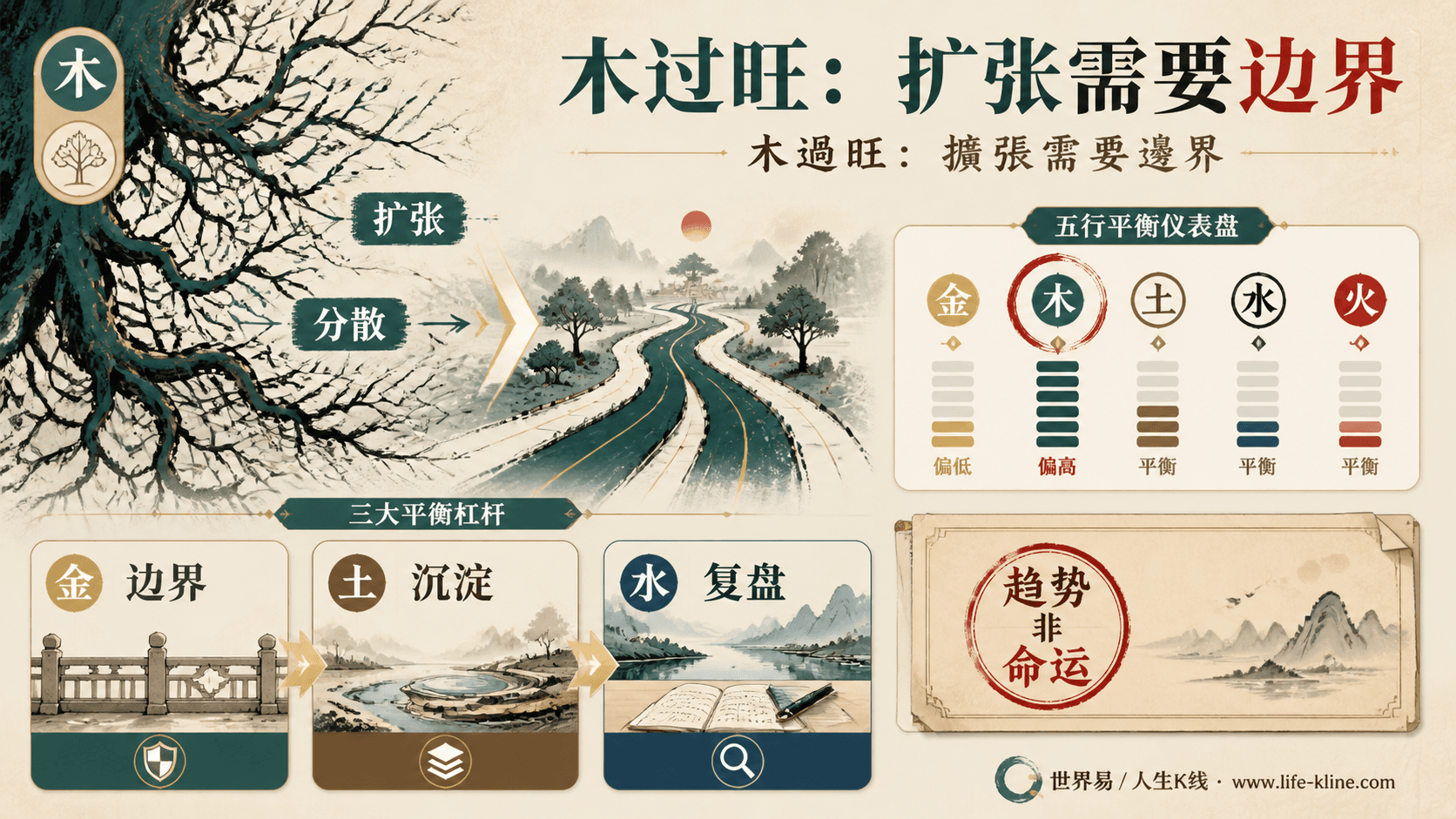
这张图把《Key Nourishing Stages During Postpartum Depression Recovery Period》里的命理概念转成关系、边界和应用场景,适合先看图建立结构,再回到案例正文理解细节。
木过旺常表现为扩张过快、计划繁多、方向分散。在人生K线系统中,这是一种时位特征,而非固定标签。通过引入边界、沉淀与复盘,可实现自然再平衡,导向更可持续的结构。
查看图片解读