Practical Lifestyle Adjustments in Chronic Disease Family Care
先看完案例关键信息,再进入分析页验证自己的结构与阶段。
Client Background
The client is a working young man aged between 25 and 30, characterized by a steady personality and strong sense of responsibility. Currently, he faces the pressure of caring for his parents who suffer from chronic diseases. As the primary caregiver in the family, he must balance his work while managing his parents' daily health needs and feels confused especially about lifestyle adjustments.
The parents’ chronic illnesses require long-term stable lifestyle habits. The client hopes to find a lifestyle plan that not only aligns with his parents’ constitutions but also fits his own rhythm, ensuring family harmony and sustained health maintenance. This creates an urgent need for a scientific and feasible lifestyle alignment strategy.
BaZi Chart Structure Interpretation
The client’s BaZi chart shows a Day Master of Ji Earth (己, Ji), which is relatively strong, indicating he possesses strong internal stability and carrying capacity. This is beneficial for shouldering family responsibilities and caregiving work. The Zheng Yin (Proper Seal) pattern reveals his aptitude for learning and absorbing new knowledge, making him suitable for adopting scientific and systematic health management methods.
The Yong Shen (favorable elements) are Wood and Water, meaning lifestyle choices should tend to increase Wood and Water elements—for example, spending more time in nature, maintaining adequate hydration, and promoting body flexibility and circulation. The Ji Shen (unfavorable element) is Fire, so excessive fatigue, intense emotions, or overheated environments should be avoided as these factors may increase physical burden.
Currently, he is in the Ji Wei (己未, Ji Wei) Da Yun (decade luck cycle), which represents a stable and conservative phase. This suggests that his health and caregiving strategies should prioritize steadiness rather than radical changes. The Liu Nian (annual fortune) is Bing Wu (丙午, Bing Wu), which brings potential changes requiring the client to maintain some flexibility and adjust appropriately to sudden health fluctuations.
Focused Problem Assessment
Regarding the lifestyle alignment issue in parental chronic disease care, it is crucial to avoid excessive physical and mental consumption for both the client and his parents. Especially avoid the influence of Fire, such as excessive sun exposure, high-temperature environments, or large emotional swings, all of which negatively impact health. Therefore, the family environment should be kept cool and well-ventilated to reduce excessive Fire energy.
At the same time, Wood and Water elements should be strengthened. Wood symbolizes growth and expansion; it is recommended to increase green plants at home and engage regularly in outdoor activities like walking or light gardening to help relax the body and mind. Water represents flow and nourishment; ensuring sufficient water intake and moderate water therapy activities such as foot baths or gentle swimming can promote blood circulation and metabolism.
Since the Ji Wei (己未, Ji Wei) Da Yun is stable and the Bing Wu (丙午, Bing Wu) Liu Nian brings some variability, lifestyle adjustments should not be rigid but flexible according to actual conditions. For example, if the parents’ health fluctuates, the client should promptly adjust their routine and diet instead of rigidly adhering to a fixed plan.
Recommended Actions and Timing
It is recommended that the client develop a lifestyle maintenance plan focused on steadiness, including moderate daily outdoor activities while avoiding strong midday sunlight. Attention should be paid to keeping warm during large temperature differences in the morning and evening to prevent excessive Fire energy from causing discomfort. Weekly scheduled water therapy sessions, such as foot baths and warm baths, can promote blood circulation and enhance the role of Water element internally.
In terms of diet, prioritize foods that nourish Yin, moisten dryness, clear heat, and detoxify. Avoid spicy, stimulating, and overly greasy dishes to prevent Fire energy accumulation. The client should gradually implement these adjustments during the early stage of the Ji Wei (己未, Ji Wei) Da Yun (around ages 28-30), leveraging the stable energy of the Da Yun to establish a solid foundation.
Given the variable nature of the Bing Wu (丙午, Bing Wu) Liu Nian, the client needs to maintain flexibility. When the parents’ health shows abnormal fluctuations, promptly adjust the plan by increasing rest, reducing activity, or consulting professional doctors. An overall lifestyle evaluation is advisable at each annual Liu Nian transition to ensure alignment with actual needs.
Review and Reminders
During the implementation of lifestyle adjustments, the client must be cautious not to make overly drastic changes in haste. The warning about avoiding Fire is particularly important; excessive fatigue and emotional volatility are major taboos in chronic disease care. Maintaining a calm mindset is key. It is essential not to disrupt the stability of daily routines, especially sleep and diet regularity.
Moreover, although BaZi provides guidance on Yong Shen and Ji Shen, health management must still be combined with medical knowledge and actual physical conditions for scientific judgment. Lifestyle alignment is a dynamic process; the client should continuously observe the parents’ physical feedback and adjust timely, avoiding blind reliance on a single method.
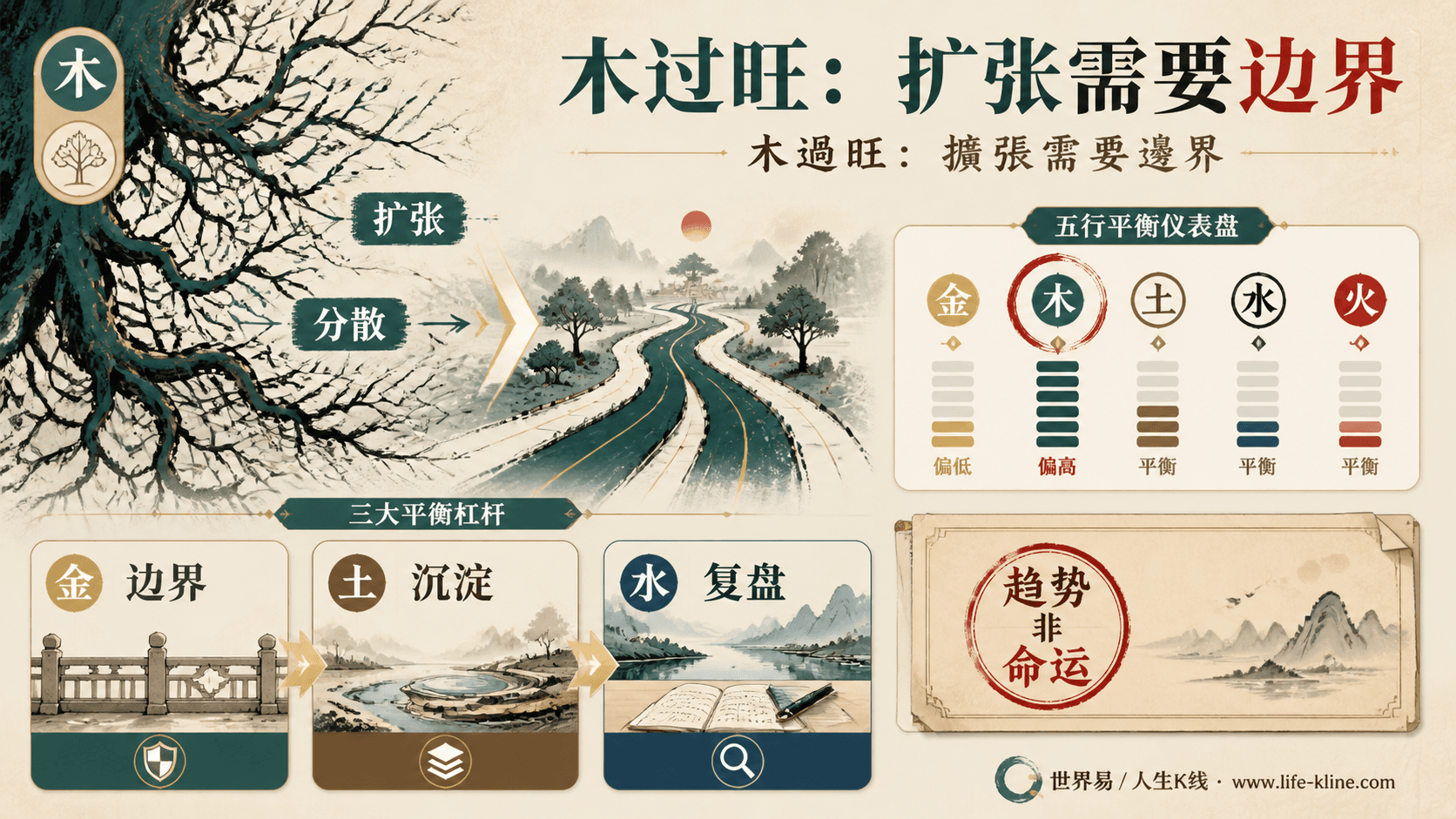
木过旺与再平衡
这张图把《Practical Lifestyle Adjustments in Chronic Disease Family Care》里的命理概念转成关系、边界和应用场景,适合先看图建立结构,再回到案例正文理解细节。
木过旺常表现为扩张过快、计划繁多、方向分散。在人生K线系统中,这是一种时位特征,而非固定标签。通过引入边界、沉淀与复盘,可实现自然再平衡,导向更可持续的结构。
查看图片解读