Practical Lifestyle Adjustments for a 25-Year-Old Man with Recurrent Gastrointestinal Issues and Relatively Weak Earth Element
先看完案例关键信息,再进入分析页验证自己的结构与阶段。
Client Background
The client is a male aged between 25 and 30, currently at the early stage of his career with significant work pressure and a fast-paced lifestyle. Over recent years, he has suffered recurrent gastrointestinal discomfort manifested as indigestion, bloating, and intermittent stomach pain. Despite multiple medical consultations, recovery has been unsatisfactory, adversely affecting his quality of life. He has good family support but is unfamiliar with combining scientific health maintenance and metaphysical guidance, hoping to receive targeted lifestyle advice from a BaZi perspective.
His lifestyle habits tend toward eating out and social engagements, with irregular sleep patterns. His diet includes a high intake of greasy and spicy foods, and he lacks systematic exercise. Psychologically, he experiences occasional anxiety, which affects the gastrointestinal nervous reflexes, further exacerbating symptom recurrence. The client wishes to start with lifestyle changes, integrating his BaZi characteristics to find a sustainable health maintenance plan.
BaZi Chart Structure Analysis
The client's BaZi chart shows a Day Master of Yi Wood (乙木), which is relatively strong, reflecting abundant vitality and determined willpower. However, strong Wood inevitably exerts some control over Earth. From the combination of the four pillars' Heavenly Stems and Earthly Branches (干支), the chart is dominated by strong Wood and Fire elements, while the Earth element is relatively weak. Physically, this often correlates to insufficient spleen and stomach function, as the gastrointestinal system symbolizes Earth, making digestive and absorption issues more likely.
The chart contains a Yang Ren (羊刃) pattern, indicating a strong personality and abundant inner energy, but also the possibility of bodily function imbalance due to excessive pressure. The client is currently in the Wu Chen (戊辰) Da Yun, where Earth's strength gradually increases. The overall luck cycle is stable, suggesting a conservative approach rather than aggressive changes, emphasizing steady health maintenance. Meanwhile, the current Liu Nian is Bing Wu (丙午), with strong Fire energy. Fire generates Earth, which can help Earth’s function, but excessive Fire may increase gastrointestinal burden, triggering recurrent discomfort.
Both the Yong Shen (用神) and Ji Shen (忌神) are Water. Water nourishes Wood and controls Fire, but the Water element in the chart is weak, and Water is also a Ji Shen. This indicates limited regulatory capacity of Water, and excessive Water input may disrupt the chart’s balance. This warns the client to moderate water intake in diet and lifestyle, avoiding indiscriminate increase.
Focused Problem Assessment
Regarding the client’s recurrent gastrointestinal issues and relatively weak Earth element, emphasis should be placed on strengthening spleen and stomach function while avoiding further damage caused by excessive Fire energy. Given the current Da Yun’s increasing Earth strength, it is advisable to follow the trend and gradually enhance Earth’s health foundation rather than making drastic changes, which aligns with the client’s still unstable gastrointestinal condition.
Since the Day Master Yi Wood (乙木) is strong, excessive Wood energy easily depletes Earth energy, leading to spleen and stomach weakness. Therefore, lifestyle adjustments should avoid excessive intake of raw, cold, and spicy foods that boost Wood energy excessively. Instead, a diet that gently warms and tonifies the spleen and stomach and supports Earth generating Metal is preferable. The Fire energy of the Liu Nian Bing Wu (丙午) increases gastrointestinal burden, so mental stress relief is also critical. Proper emotional regulation and anxiety avoidance benefit the stability of gastrointestinal nervous function.
Water is both Yong Shen and Ji Shen, indicating water intake must be cautious. It is best to consume mild, nourishing water and moderate amounts, avoiding cold drinks and excessive water consumption that can disrupt gastrointestinal function. For exercise, gentle aerobic activities such as walking or Tai Chi are recommended to promote qi and blood circulation without overexertion, thereby helping regulate spleen and stomach function.
Recommended Actions and Timing
In the next six months, the primary focus should be on adjusting the diet structure by avoiding cold, raw, greasy, and spicy foods. Increase intake of fiber-rich and easily digestible foods such as Chinese yam (山药), red dates (红枣), and pumpkin, which gently tonify the spleen and stomach. Reduce raw food and cold beverages, maintaining warm meals to alleviate gastrointestinal burden. Following the stable principle of the Wu Chen (戊辰) Da Yun, dietary adjustments should be gradual and steady, avoiding sudden drastic changes.
In the following three months, establish a regular sleep schedule ensuring adequate rest and reduce late nights. Combine moderate exercise such as walking or Tai Chi to promote qi and blood flow and strengthen spleen and stomach function. This phase should also emphasize emotional management; daily meditation or breathing relaxation exercises are recommended to reduce the mental anxiety caused by the strong Fire of the Bing Wu (丙午) Liu Nian, supporting the stability of the gastrointestinal nervous system.
Within the next year, it is advisable to conduct quarterly self-assessments of physical condition and adjust health maintenance priorities according to seasonal changes. In spring and summer, moderately increase foods that soothe the liver and regulate qi; in autumn and winter, focus on nourishing the spleen and stomach and avoiding cold dampness invasion. Avoid blindly taking tonic medicines; respect the body’s responses and BaZi rhythm, coordinating with Da Yun and Liu Nian cycles to steadily improve health levels.
Review and Reminders
During the practical implementation of lifestyle adjustments, beware of over-reliance on any single method, especially water intake. Since Water is both Yong Shen and Ji Shen in the chart, improper use can easily cause bodily imbalance. Health maintenance should focus on overall balance and avoid偏颇 (偏颇 means 'one-sidedness' or 'imbalance').
At the same time, the client needs to maintain patience. The Wu Chen (戊辰) Da Yun is a phase favoring stability and consolidation. Physical and mental adjustments and improvements will not happen overnight. Avoid impatience and excessive anxiety; instead, build good lifestyle habits steadily to achieve long-term gastrointestinal health improvement.
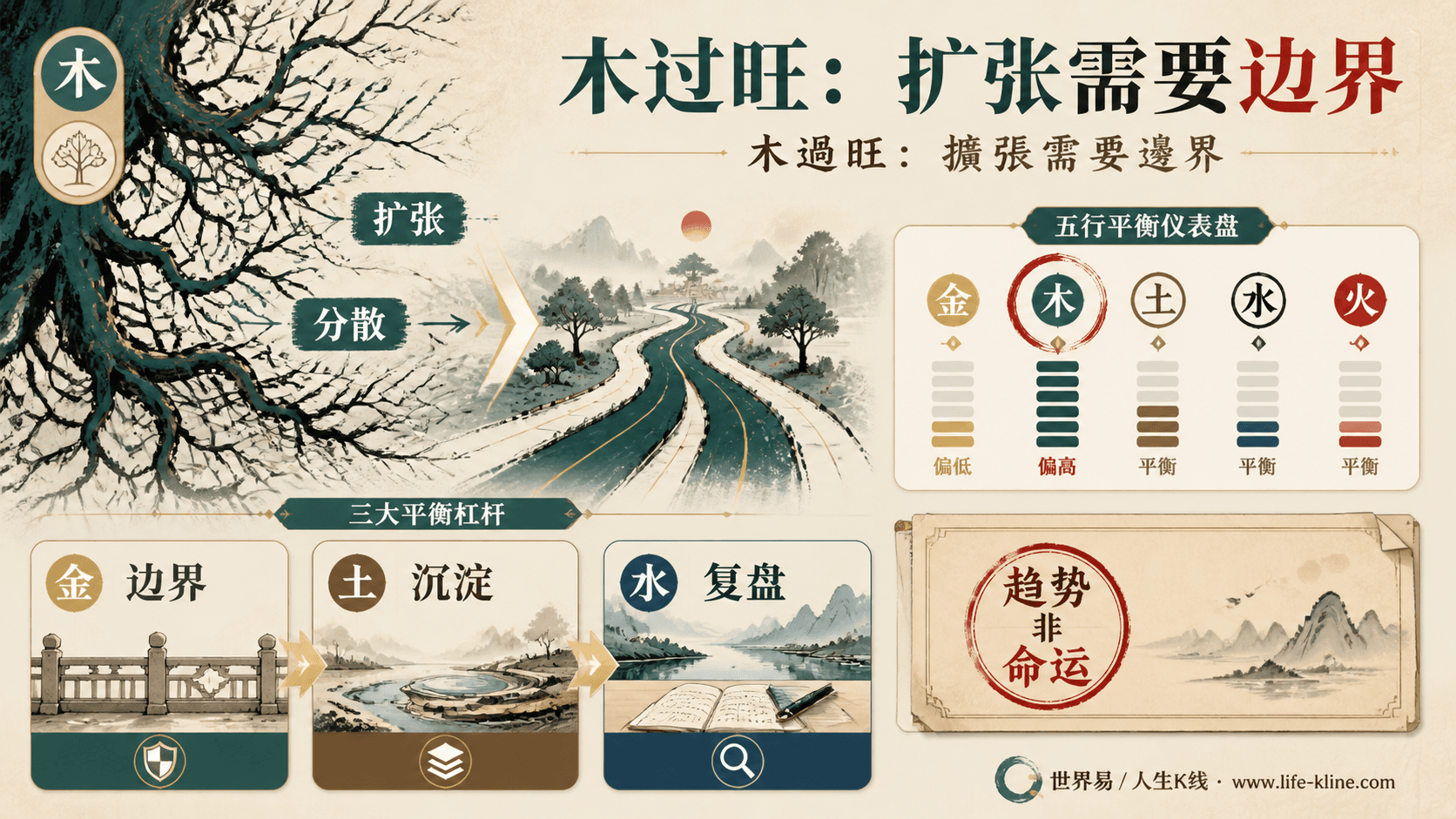
木过旺与再平衡
这张图把《Practical Lifestyle Adjustments for a 25-Year-Old Man with Recurrent Gastrointestinal Issues and Relatively Weak Earth Element》里的命理概念转成关系、边界和应用场景,适合先看图建立结构,再回到案例正文理解细节。
木过旺常表现为扩张过快、计划繁多、方向分散。在人生K线系统中,这是一种时位特征,而非固定标签。通过引入边界、沉淀与复盘,可实现自然再平衡,导向更可持续的结构。
查看图片解读