Mid-Level Manager's Transition from Big Corporation to Entrepreneurship: The Choice Between Stability and Change under the Yi Si Da Yun
先看完案例关键信息,再进入分析页验证自己的结构与阶段。
Client Background
The client is a male aged between 35 and 40, who has held a mid-level management position in a well-known large domestic internet company for eight years, possessing rich industry experience and management capabilities. As he grows older and accumulates professional experience, he has begun to consider stepping out of the corporate framework to start his own business. However, this is accompanied by anxiety about timing, fearing that leaving his comfort zone might cause him to miss the best window, thus affecting his career development.
On the family front, the client bears certain financial responsibilities, and a stable income and living environment are important considerations at present. Facing the career transition decision, he hopes to both secure his existing solid foundation and seize suitable opportunities to seek new breakthroughs in his career.
BaZi Chart Structure Interpretation
The client’s BaZi chart indicates he follows the Zheng Guan (正官) pattern, with the Day Master being Jia Wood (甲木), which is overall relatively weak. This shows that his own strength requires external resources’ support and coordination. A Wood Day Master that is weak benefits from Water as the Yong Shen (favorable element) to nourish it, helping the client realize his potential and enhance adaptability. Fire and Earth are Ji Shen (unfavorable elements), representing excessive pressure and depletion that can weaken his foundation and resource stability.
Currently, the client is at the end phase of the Yi Si (乙巳) Da Yun. This Da Yun is a stable cycle, emphasizing consolidation and accumulation. Yi Wood (乙木) is of the same element type as the Day Master Jia Wood (甲木), while Si Fire (巳火) is a Ji Shen, but because the overall Da Yun is stable, it implies that the client should focus on steadiness and avoid excessive risk-taking at this time. Meanwhile, the current Liu Nian is Bing Wu (丙午), characterized by strong Fire, bringing certain changes and challenges, indicating the client needs to respond flexibly and adjust strategies accordingly.
Focused Issue Judgment
Regarding the client’s concern about whether it is suitable to leave the big corporation now and choose entrepreneurship, the BaZi shows he is in a phase of stability mixed with change. The Yi Si Da Yun is overall stable, favoring consolidation and accumulation. This aligns with the client’s current stable mid-level position in the corporation, suggesting that large-scale aggressive moves carry high risks and may encounter negative effects from the Ji Shen Fire and Earth elements.
However, the Bing Wu Liu Nian has strong Fire, which, although a Ji Shen, also brings certain opportunities and challenges. It reminds the client to respond flexibly and not rigidly adhere to old patterns. The presence of Fire in the Liu Nian increases pressure but also prompts the client to identify potential problems and breakthrough points. Therefore, the current Da Yun calls for steady progress—on the basis of consolidation, the client should prepare for entrepreneurship and conduct market research, accumulating resources and networks rather than rushing to quit entirely.
From a long-term perspective, the client can utilize the accumulation at the end of the current Da Yun and wait for the next Da Yun cycle, which supports innovation and breakthroughs, to launch full-scale entrepreneurial efforts. The key now is to solidify existing advantages and avoid prematurely rushing forward, which could cause missing better opportunities.
Recommended Actions and Timing
Based on BaZi analysis, the most suitable strategy for the client currently is to be steady yet proactive. First, he should continue to hold his current position in the big corporation, consolidating management experience and industry resources, while actively expanding external networks and market information to prepare for future entrepreneurship. It is recommended that the client strengthen connections in Water-related fields, such as information flow and resource integration, to supplement the relatively weak Wood Day Master.
Secondly, the client can leverage the Fire energy changes in the current Liu Nian to moderately try small-scale side businesses or projects, testing the feasibility of entrepreneurial ideas and accumulating practical experience, thus avoiding the risks of an all-out immediate departure. This approach responds to the Liu Nian’s demand for change while not contradicting the overall Da Yun trend of maintaining stability.
Regarding timing, the Yi Si Da Yun will end in the next few years. The client should plan major entrepreneurial activities after the new Da Yun begins. If the new Da Yun brings strong Water or Wood support, it will be the optimal window. At that time, relying on the accumulated resources and experience, the probability of entrepreneurial success will greatly increase.
Review and Reminders
It is important to remind the client that while BaZi can indicate general trends, ultimate success depends on actual actions and market conditions. One must avoid rushing breakthroughs at the expense of a solid foundation. Especially when the Ji Shen Fire and Earth are excessive, it can cause great depletion, affecting physical and mental health as well as sustainable career development.
Additionally, entrepreneurship involves many uncertainties. The client should maintain a flexible mindset, emphasize risk control, and avoid impulsive decisions that might miss better development opportunities. BaZi suggests prioritizing stability with progress amid movement. By combining this with his actual situation, the client can seize the current window and move toward a more stable new stage in his career.
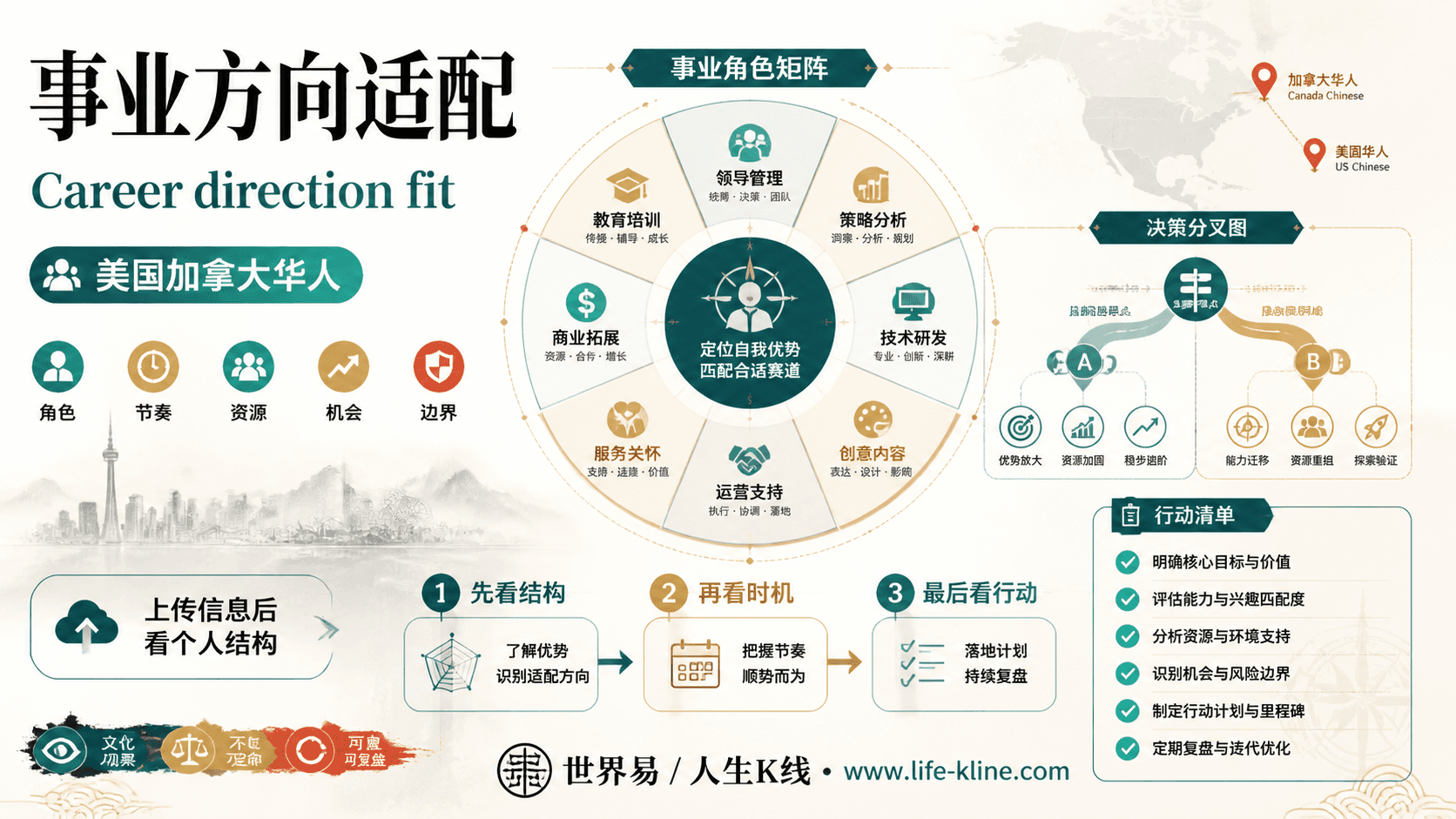
事业方向适配|美国加拿大华人
这张图把《Mid-Level Manager's Transition from Big Corporation to Entrepreneurship: The Choice Between Stability and Change under the Yi Si Da Yun》里的命理概念转成关系、边界和应用场景,适合先看图建立结构,再回到案例正文理解细节。
事业方向适配不应被写成固定结论。更适合美国加拿大华人的读法,是把传统术语翻译成结构、时机、环境、行动和复盘。
查看图片解读